
The stories we tell ourselves eventually stop sounding like stories
7/27/20263 min read
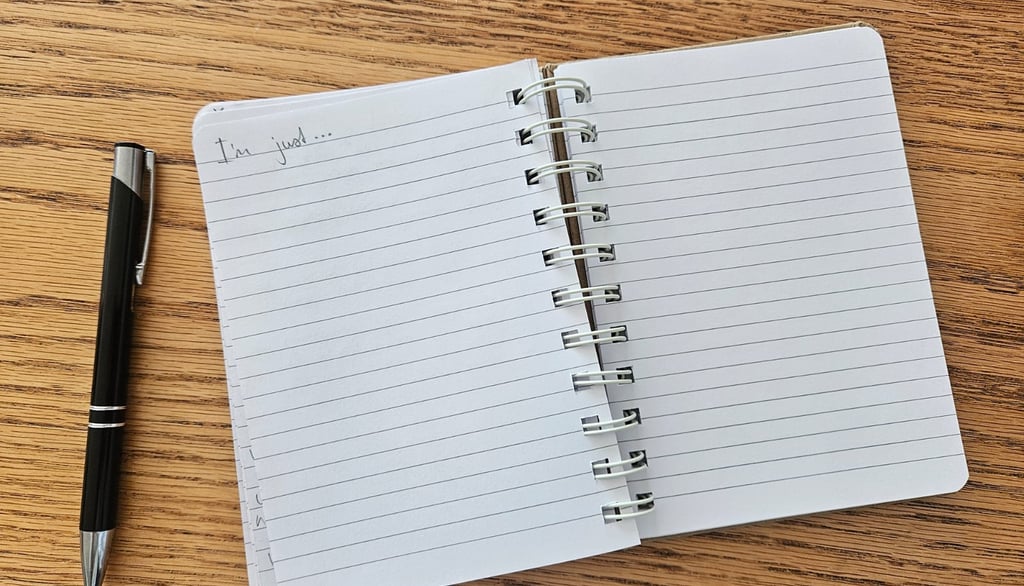
I've always found it curious how easily we question information, yet how rarely we question ourselves.
We will read reviews before booking a restaurant, compare articles before forming an opinion, and happily update our beliefs when new evidence presents itself. We know the world is complicated, that first impressions are often wrong and that certainty should be treated with caution.
Yet when it comes to ourselves, we often live by conclusions we haven't revisited in years. "I'm not creative." "I've never been good with money." "I'm terrible under pressure." "I'm just an anxious person."
What's interesting isn't that we say these things. It's how we say them.
Not as observations. As facts. As though they were measured, tested and proven beyond doubt.
I again caught myself doing it recently. I was about to say, "I've never been good at..." when something stopped me. I realised I couldn't remember where that belief had come from.
Had I decided that ten years ago? Twenty? Was it something a teacher once said? A single failed attempt? Or had I simply repeated it often enough that it no longer felt like a conclusion at all? It felt like reality.
That, I think, is one of the stranger things about being human. Stories have a habit of disappearing, because, over time, we stop recognising them as stories. They become the lens through which we see ourselves. And once something becomes a lens, it becomes incredibly difficult to notice.
Imagine meeting someone who introduced themselves by saying, "I'm terrible under pressure."
Your first instinct would probably be to wonder why they believed that. You might ask what happened. You'd look for context. You'd want evidence before accepting such a sweeping conclusion.
Yet many of us make those same statements about ourselves without asking a single follow-up question. We treat our own identities with less curiosity than we would extend to a stranger.
I wonder how often our lives are shaped, not by reality itself, but by descriptions of ourselves that quietly expired years ago.
Perhaps you struggled with maths at school and concluded you weren't a numbers person. Years later, you avoid opportunities that involve numbers, reinforcing a belief that was built on the performance of a fourteen-year-old.
Perhaps someone described you as shy when you were a child. You repeated it often enough that it became part of your introduction, even though the person you have become bears little resemblance to the one who first earned the label.
Perhaps you failed at something once, and somewhere along the way that failure stopped being an event and became an identity.
What's remarkable is that we rarely notice this happening. We assume our self-image has kept pace with our growth simply because we've been present for all of it.
But that's not how stories work. The more often they're repeated, the less they sound like stories and the more they sound like truth.
There's a reason eyewitnesses can be so unreliable, even when they're completely convinced they're remembering events accurately. Memory is not a recording. Every time we recall an experience, we reconstruct it. We edit it, simplify it and fit it into a narrative that makes sense of who we believe ourselves to be.
Perhaps we do something similar with our identities. We don't just remember who we are. We continually rewrite ourselves into a story that feels coherent.
The problem is that coherence and accuracy are not the same thing. None of this means our stories are false. Many of them contain something deeply true.
The question is whether they've been examined recently. Whether they've been tested against the person we've become instead of the person we once were. Because there is a quiet difference between self-awareness and self-certainty.
Self-awareness remains curious. Self-certainty assumes the story is finished.
I've started to wonder whether one of the greatest obstacles to growth isn't that we believe the wrong things about ourselves. It's that we've forgotten those beliefs were interpretations in the first place.
Perhaps that's why change can feel so difficult. Not necessarily because we're changing who we are, but because we're questioning the voice that has been telling us who we are for years.
We question the news We question history. We question science. We question one another.
Yet the longest conversation we'll ever have is with ourselves, and it may be the one we question the least.
Mikki McIntyre is the founder of Aspasiana and creator of the Rise Resilient Method. Drawing on over ten years of experience as an environmental scientist, project leader and process engineer, she helps people in high-stakes, high-impact roles master their internal "operating systems." She specialises in teaching the nervous system skills required to maintain clarity and resilience in demanding, complex environments, ensuring that high performance never comes at the cost of well-being.
Let's build capacity that creates impact.
© 2026 Aspasiana. All rights reserved.
Whether you're investing in yourself or your team, we'd love to help you take the next step.

